Revenue rarely vanishes in one dramatic place. It seeps out at the seams — the quiet junctions between two teams that each believe they did their job. Marketing hit its number. Sales worked what it was given. And somewhere in between, pipeline leaked. Knowing where sales and marketing pipeline leaks is the difference between fixing the funnel and arguing about it for another quarter.
This is a map of the exact junctions where it happens. Not a pep talk about alignment. Five specific places, what the leak looks like from inside your own org, and the tell you can usually only see from outside.
Why the leak is invisible from the inside
Each team measures its own half. Marketing is held to lead volume and cost per lead. Sales is held to closed revenue and quota. Both scorecards are reasonable on their own. Neither one owns the middle.
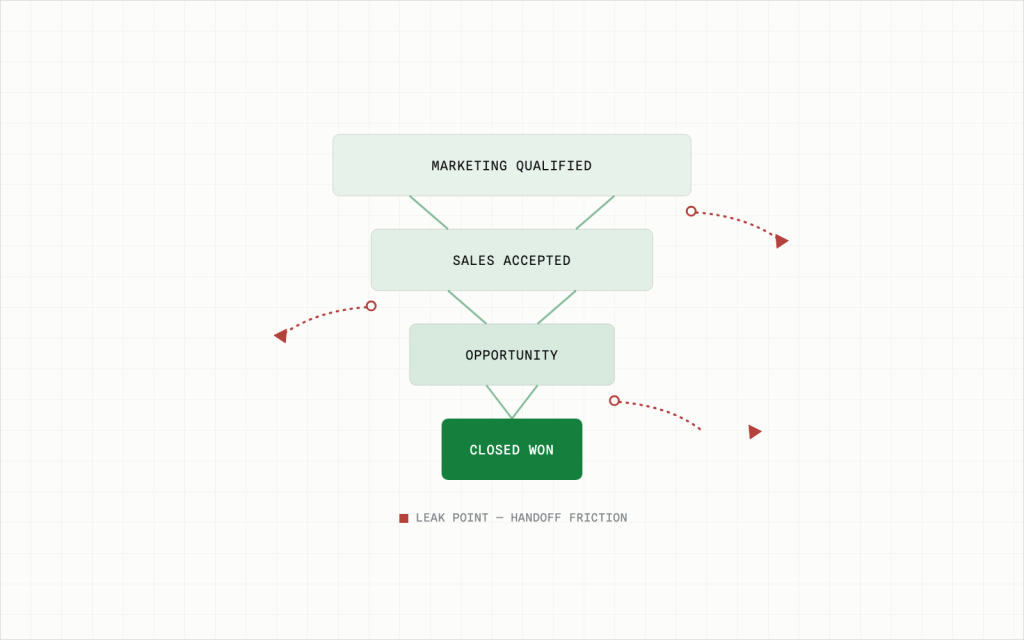
That middle — the stretch from marketing qualified lead to sales accepted lead to opportunity — is where the handoff happens. It is also where nobody's number lives. Marketing's job ends when the lead is "qualified." Sales' job begins when it decides the lead is worth a call. The gap between those two judgments is unmeasured, unowned, and almost always where the leak sits.
You can't see it from a single dashboard because no single dashboard spans both sides. Marketing's report stops at MQLs delivered. Sales' report starts at opportunities created. The leads that disappear between those two lines never show up as a loss on anyone's chart. They just quietly fail to convert, and each team assumes the other side dropped the ball.
The five places B2B pipeline leaks
Pipeline leaks at five recurring junctions. Walk your own funnel against this list before you spend on a fix.
- The definition gap — sales and marketing don't agree on what "qualified" means.
- The handoff itself — accountability transfers with no shared "ready" and no system catching what falls through.
- Response time — qualified leads sit untouched until the buying moment has passed.
- Enablement and content — marketing produces material sales never uses.
- Shared metrics and the SLA — no written agreement holds the handoff accountable.
1. The definition gap
This is the first and most expensive leak, because everything downstream inherits it. Marketing scores a lead on engagement — opened the email, downloaded the guide, hit the pricing page. Sales rejects the same lead on fit and authority — wrong company size, no budget, not a decision-maker.
Both are using the letters "MQL." They mean different things by them. The result is a queue of leads marketing counts as wins and sales counts as noise. Industry research consistently finds that a small minority of B2B organizations have a documented, shared definition of a qualified lead — and surveys of sales leaders regularly report that a large share say their idea of an MQL differs significantly from marketing's. When the two halves of the funnel are scoring on different criteria, the leak isn't a process failure. It's a definition failure, and no amount of effort downstream closes it.
2. The handoff itself
The handoff is the moment accountability transfers. In a healthy funnel, it's a defined event — a lead crosses an agreed threshold, gets routed to a named owner, and someone is responsible for the next touch. In most funnels, it's an assumption. The lead lands in a CRM queue. Marketing assumes sales picked it up. Sales assumes the ones worth pursuing will resurface.
So leads fall through. Third-party analyses of the marketing-to-sales handoff put the share of MQLs that die at this junction above half — not because the leads were bad, but because nothing caught them when accountability changed hands. There was no shared signal for "ready," and no system flagging the ones that sat. The handoff is where a lead is most likely to disappear precisely because it's the one moment neither team fully owns.
3. Response time
A qualified lead has a half-life. Interest decays fast, and the buyer is usually talking to more than one vendor. The first credible response often wins the conversation before the others have noticed the lead exists.
Most teams are nowhere near fast enough. Widely cited lead-response studies have measured average time-to-first-touch in hours — sometimes well over a day — against an optimal window measured in minutes. Worse, a meaningful share of inbound leads are never contacted at all. They get logged, scored, and left. From the inside this looks like a volume problem: "we need more leads." It's often a speed problem wearing a volume problem's clothes. The leads were there. The funnel just didn't reach them in time.
4. Enablement and content
Marketing produces. Sales ignores. This is the most documented gap in the relationship, and the most quietly wasteful. The pattern shows up everywhere: a content library full of decks, one-pagers, and case studies, of which sales actually uses a handful in live deals. The rest gets built, filed, and never opened.
The leak here is subtle because nothing visibly breaks. Leads still convert, sometimes. But reps improvise their own materials, the message drifts from what marketing put in market, and the deal cycle stretches because the right asset wasn't there at the right moment. When the content a buyer encounters in a sales conversation doesn't match what pulled them in, trust erodes — and a pipeline built on a clear promise leaks against a muddled follow-through.
5. Shared metrics and the SLA
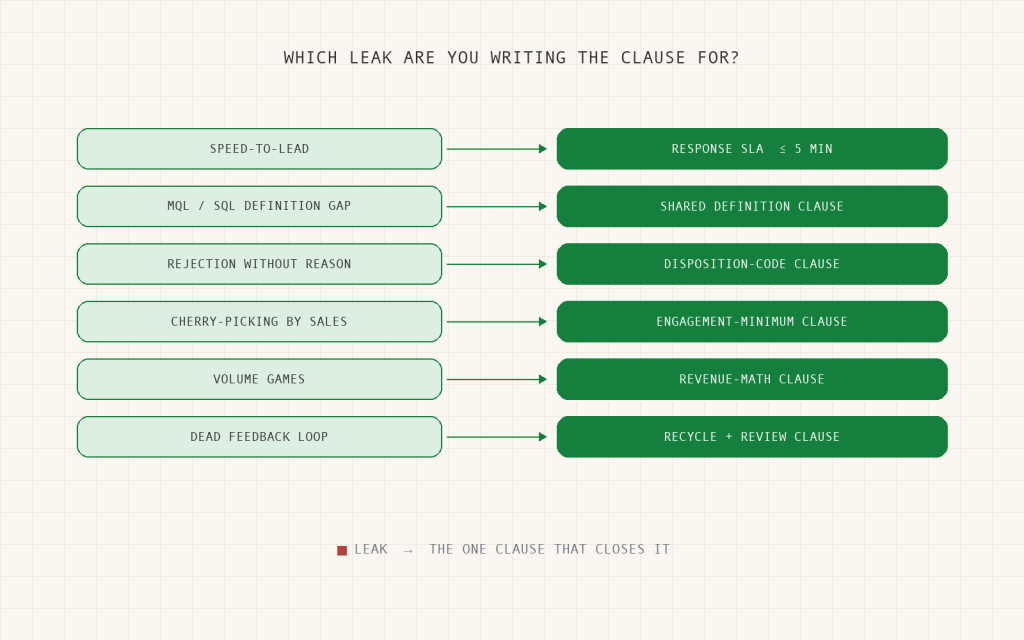
The four leaks above share a single root: there is no contract between the two teams. No service-level agreement specifying what a qualified lead is, how many marketing will deliver, how fast sales will respond, and what happens when either side misses.
Most B2B organizations don't have one. Industry surveys repeatedly find that a large majority of sales and marketing teams operate with no formal SLA between them. Without it, the two functions run on separate scorecards toward separate goals, and "alignment" is a word in a meeting rather than a number anyone is accountable to. This is the structural leak. The other four are symptoms of it.
How to spot which leak is yours
Five junctions, but they don't all leak equally in every company. The question that matters is which one is costing you the most. Some of that you can read from inside. Some of it you genuinely can't.
The signals you can see from inside
You already have most of the symptoms in front of you. Watch for the recurring patterns:
- Sales complains about lead quality every quarter, in almost the same words.
- Marketing defends lead volume every quarter, in almost the same words.
- Campaigns go live that sales didn't know were running.
- The MQL queue fills steadily but the opportunity count doesn't move with it.
These tell you a leak exists. They rarely tell you which one, because each team reads the same symptom as proof the other side is at fault.
The signals you can only see from outside
Two questions decide where you actually spend effort, and neither answers cleanly from inside the org.
First: is the "lead quality" complaint real, or is it a definition artifact? If sales and marketing never agreed on what qualified means, "bad leads" might just be leads sales never accepted the criteria for. Telling the difference requires reading both teams' definitions against the actual leads — objectively, without a stake in whose fault it is.
Second: which leak is biggest by revenue impact? That needs a real pull — a ranked look at where leads actually drop across a meaningful window of pipeline, scored by what each junction costs. It's the kind of analysis a team rarely runs on itself, because everyone inside is invested in a particular answer.
You can't read the label from inside the jar. The symptoms are visible to you; the objective ranking of causes usually isn't.
This is the part that's hard to do from where you stand. Both teams are too close, and too invested, to score themselves objectively.
Mapping the leak vs. fixing the leak
Here's the honest line. You can map the symptoms yourself. The list above is a real diagnostic, and a sharp revenue leader can walk the five junctions and form a hypothesis. That's worth doing.
What's hard to do from inside is name the real root cause objectively, and rank the leaks by what they actually cost. That requires an outside read of both teams' definitions, the handoff mechanics, and the data — without a stake in whose half is to blame. A structured alignment audit exists for exactly that: it produces a ranked diagnosis of where your pipeline leaks and what to point your team — or your agency — at first. See how the diagnostic works.
Mapping is the work you can do. Diagnosing is the work that's hard to do on yourself. Different problems can feel identical from the inside — which is also why it's worth confirming you have a leak at all, and not a demand problem rather than an alignment problem, before you start patching seams.
Common questions
The FAQ below renders from the post's structured FAQ field, so these answers also appear as an accordion on the page.
Map the symptoms. Then get them named.
The leak is at the seams. It's measurable, it's fixable, and it's almost always one or two of the five junctions doing most of the damage — not all of them equally. The catch is that the leak is nearly impossible to name objectively from inside, where every team reads the same symptom as the other side's fault.
So map your symptoms against the five. Form your hypothesis. Then get an objective, ranked read of where your pipeline actually leaks and what to point your team at — that's what a marketing alignment audit is for. Book the audit when you're ready to stop guessing and name the real one.