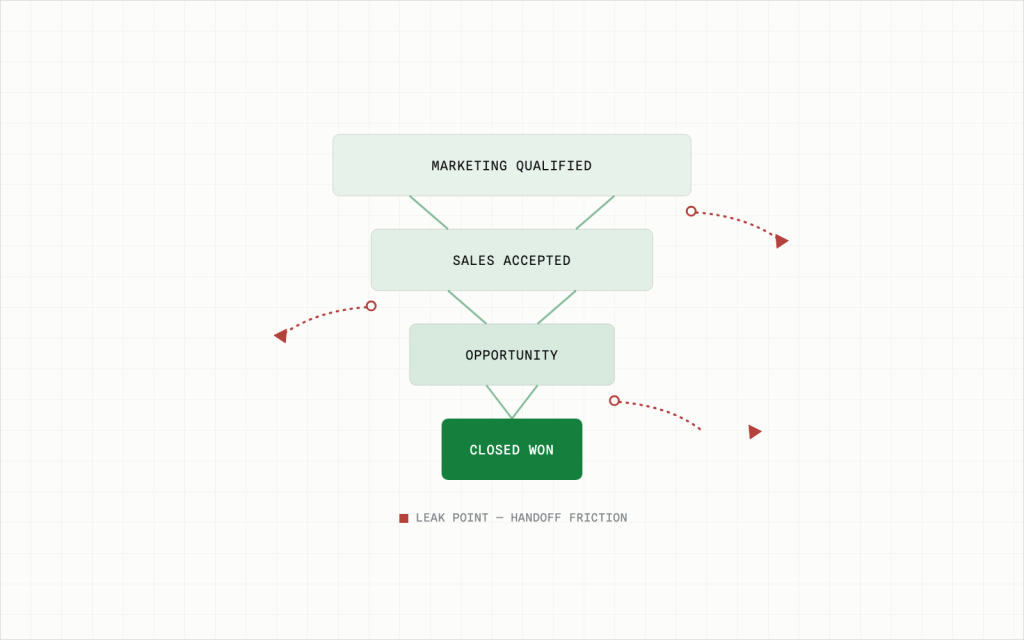
Most B2B teams either have a sales and marketing SLA nobody enforces, or no SLA at all and a quiet suspicion they should. ArtemisGTM puts the share of B2B companies with no documented agreement between the two teams at 73%. The ones who do have something usually downloaded a template, signed it, filed it, and kept losing pipeline at the same seams.
The template approach fails upstream of the document. A sales and marketing SLA only closes a leak if you write it backward — start from the specific leak in your funnel, then name only the four or five clauses that close that leak. Written forward from a checklist, it plugs holes you don't have and ignores the one you do. What follows is the six-leak diagnostic and the clause language that closes each.
Key takeaways: when a sales and marketing SLA actually closes a leak
Templates don't close leaks. Diagnosis does. The rest of this article walks the six leaks every B2B funnel produces and the clause that closes each, so by the end you know which four or five belong in your document; the rest are contract noise.
Industry benchmarks suggest companies with a documented agreement respond to inbound leads inside 15 minutes far more often than companies without one. The percentages move with the survey, but the gap is consistent. ArtemisGTM puts the unaligned average response at roughly 39 hours, about 78 times slower than the optimal window.
- An SLA is a leak-closing contract, not a checklist of generic clauses.
- The most common leak is speed-to-lead, not volume. Most teams write the agreement around the wrong number.
- Six leaks repeat across B2B funnels; each has one specific clause that closes it.
- An SLA without measurement in the CRM is not an SLA — it's a suggestion.
- You cannot write a useful agreement before you have diagnosed which leak you actually have.
If you do not yet know your leak, that is the first work. A marketing alignment audit is one objective way to find it; 90 days of your own MQL and rejection data is the other.
The six leaks every funnel SLA is supposed to close
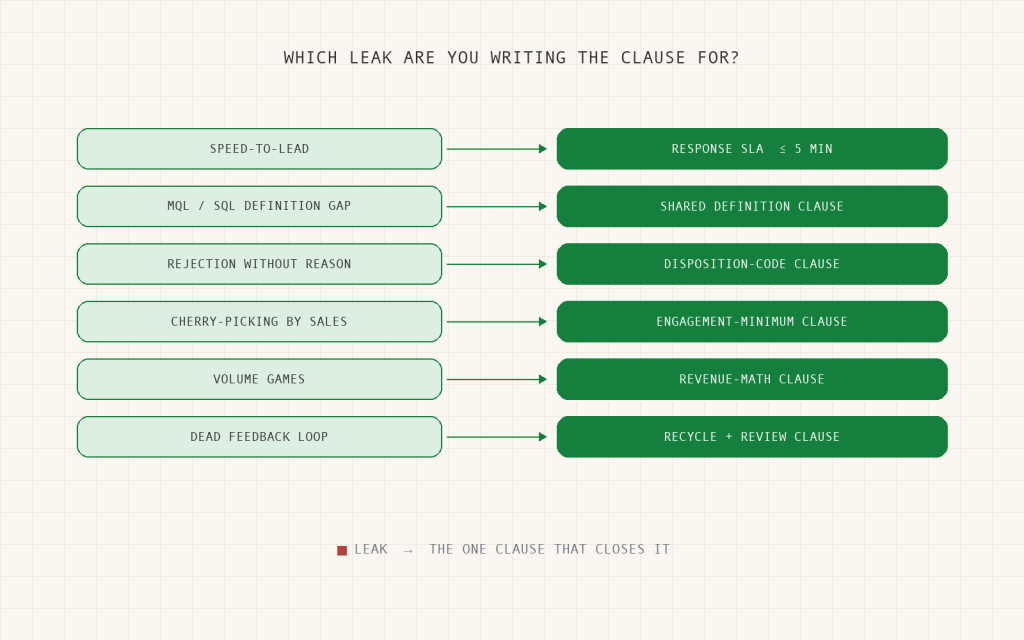
Every clause in every template exists to plug one of six specific leaks. Most teams try to plug all six at once, which is why the document gets long, generic, and unread.
In order: speed-to-lead, the MQL to SQL handoff definition gap, rejection without reasons, cherry-picking by sales, volume games by marketing, and the missing recycle and feedback loop. ArtemisGTM's data anchors the cost: 53% of MQLs die in the marketing-to-sales handoff, 44% of leads are never contacted at all, and only 8% of companies have a documented shared definition of a qualified lead. Six numbers, six problems, six different clauses.
Leak 1 — Speed-to-lead
Symptom: leads contacted more than an hour after they cross the MQL threshold. The buyer has already moved on or talked to a competitor. The Harvard Business Review lead-response study (the widely cited 15,000-lead analysis) found responses inside five minutes were dramatically more likely to produce qualification than responses at 30. ArtemisGTM puts the current B2B average around 39 hours.
Clause language: "Sales accepts contact responsibility within 5 minutes during business hours for hot-scored MQLs above the agreed engagement threshold, and within 2 hours for standard. Tracked in CRM via first_outbound_touch_at. More than two misses in a rolling week trigger a Sales–Marketing ops review."
How you'll know it worked: median speed-to-lead drops below one hour inside 30 days, and the dashboard makes misses visible to both teams.
Leak 2 — Definition gap, MQL to SQL handoff
Symptom: marketing scores a lead as qualified on engagement; sales rejects the same lead on fit and authority. Both use the letters MQL. They mean different things by them. ANNUITAS reported 49% of chief sales officers say their definition of a qualified lead differs significantly from marketing's; ArtemisGTM puts the share of companies with a documented, shared MQL/SQL definition at 8%.
The MQL to SQL handoff cannot be a clause about volume. It has to be a clause about criteria. Marko Savic of FunnelEnvy frames it well: a working gate has to be binary and measurable, with clear entrance and exit criteria. Fit, authority, engagement score, recency. Each named, each scored, each checked at the gate.
Clause language: "A lead is an MQL only if it meets all of: ICP-fit firmographics, decision-influencing title, engagement score above N within the last X days. SQL acceptance requires the same four plus a sales-confirmed conversation. Any rejection at SQL must cite which of the four failed."
How you'll know it worked: sales accept rate rises from a sub-40% baseline, and rejection codes show fewer "not really qualified" disputes.
Sales and marketing SLA clauses for rejection, cherry-picking, and volume games
These three are the middle-funnel leaks no template plugs by default, because they require both teams to give up something they like. Marketing has to accept that volume without conversion is shelfware. Sales has to accept that working only the hottest leads costs the company real revenue. A sales and marketing SLA earns its name in these three clauses, where it stops being a piece of paper and starts changing behavior.
Leak 3 — Rejection without reasons
Symptom: sales rejects a meaningful share of MQLs but nobody captures why. Marketing cannot fix a complaint it cannot see. Rejection becomes a vibe ("the leads are bad this quarter"), and the same campaigns keep running because nothing in the data says what to change. Mark Appel describes the fix as a return-path mechanism: every rejected lead carries a structured reason code back to marketing.
Clause language: "Every rejected MQL requires a disposition code from a fixed list within 24 hours. Marketing reviews rejection-reason distribution weekly; persistent patterns drive campaign and targeting changes within the following monthly cycle."
How you'll know it worked: rejection reasons cluster. The top three account for most rejections, and you can point to a specific campaign change that responded to one of them.
Leak 4 — Cherry-picking by sales
Symptom: sales works only the hottest accounts. Lower-tier MQLs sit. Marketing keeps generating them; the funnel keeps absorbing the cost; the leads decay. From a dashboard this looks like a quality problem. It's a coverage problem.
The clause is a sales engagement minimum. Pedowitz publishes a usable shape: 5 to 8 touches over 7 to 10 days for every accepted MQL regardless of score tier, with hot-tier leads still owed a response inside 15 minutes. The numbers flex with your motion. The principle does not: an accepted MQL has a touch contract attached to it.
Clause language: "Every accepted MQL receives a minimum of N outbound touches across N business days, tracked per rep in the sales engagement platform. Aged MQLs below the minimum auto-flag for review."
How you'll know it worked: the per-rep coverage chart goes flat instead of spiking on hot accounts, and lower-tier conversion rates stop being zero.
Leak 5 — Volume games by marketing
Symptom: marketing's quarterly target is a flat MQL number. To hit it, the qualification bar quietly drops. Sales sees the queue fill with leads that look qualified on paper and rejects most on the call. Marketing hits its number; the funnel rejects its number.
Sam Kuehnle has been making this point publicly for years: the MQL target should be reverse-engineered from the revenue goal, not invented by marketing as a forecast it can hit. Run the math forward: required revenue, deal size, win rate, opportunity-to-deal rate, MQL-to-opportunity rate. The MQL number falls out the bottom. Hand-set it, and you're guessing.
Clause language: "Quarterly MQL target is derived from a documented revenue-math model (revenue ÷ ASP ÷ win rate ÷ opp rate ÷ MQL-to-opp rate). Inputs reviewed quarterly. The target moves when the inputs move."
How you'll know it worked: the quarterly conversation stops being about MQL count and starts being about pipeline contribution.
The recycle and feedback-loop clause most templates skip
Leak 6 — No recycle path, no feedback loop
Symptom: sales rejects, the lead vanishes, the same lead re-enters a month later, scores as fresh, and gets rejected again. The funnel runs in circles. Nothing learns. Almost every template skips this clause because it requires both teams to keep working a lead after the immediate handoff has failed.
The working pattern comes from the Marketo / Adobe community: a formal Recycle stage with a defined hold period, disposition codes attached on entry, and a measurable re-entry rule. The lead does not disappear. It is parked, watched, and re-eligible only when something specific changes.
Clause language: "Rejected leads return to nurture under stage = Recycle for a defined hold period (commonly 30 to 60 days). The lead becomes re-eligible for scoring only when its engagement score rises by an agreed delta. Rejection reasons are reviewed monthly and feed campaign, content, and targeting decisions."
How you'll know it worked: rejected-lead conversion stops being zero; the recycle cohort produces measurable pipeline; the monthly rejection review produces specific, traceable changes.
Most teams realize they need this clause only after losing the same leads twice. The recycle leak is one of the patterns a structured marketing alignment audit surfaces by pulling 90 days of rejection data. It also separates a real demand problem or alignment problem. The recycle leak masquerades as both.
Conclusion: a sales and marketing SLA only works backward
An SLA built from a template plugs leaks you may not have and ignores the one you do. The reality is structural: most B2B companies still operate without one, and most who have one treat it as shelfware. The fix is not a longer document. It is a shorter one, written backward from the leak you actually have.
Two honest paths. Pull 90 days of your own MQL and rejection data, walk it against the six leaks above, and write the four or five clauses that close yours. Or get an objective outside read of which leak is costing the most pipeline before you write a single clause. A sales and marketing SLA is the easiest document to write badly and the hardest to write well, because writing it well requires knowing exactly which leak you have.
If you would rather not write the agreement alone, the Marketing Alignment Audit names the leak first, ranks it by revenue impact, and hands you the four or five clauses you actually need. You write the document; the diagnostic tells you what goes in it. Book the audit when you would rather diagnose first and write second.