You've been pitched both. One vendor describes a six-week RevOps diagnostic at $25K to $50K covering five revenue pillars. Another offers a fixed-scope marketing alignment audit at a smaller, defined fee. They sound like the same engagement at different price points. They are not. The wrong one at the wrong stage produces a report your team isn't yet operationally mature enough to act on. That's the classic shelf-ware outcome.
Disclosure that makes the rest of this article possible. I run the marketing alignment audit. I do not run full RevOps diagnostics. Someone who sells both has a structural incentive to recommend the bigger engagement. I don't, which is exactly why I can draw the line cleanly, including the line where the right answer is to commission someone else's engagement instead of mine.
Key takeaways: why two terms exist
The two terms are used interchangeably in the market. They describe two different engagements at two different maturity stages, and conflating them is what produces the shelf-ware report. The vocabulary collision is real even at the senior level — Sangram Vajre of GTM Partners has noted that interviewing more than a hundred executives on the definition of go-to-market produced "a hundred different answers."
The published RevOps Maturity Models cut through the fog. RevPartners publishes a five-level model (Level 1 "Organize" through Level 5). Outreach, Insidea, and Hyperscayle each publish their own five-stage variants. Across all four, Stage 1 is described in alignment language: define shared lead terms, pick a CRM, document the handoff, agree on what counts as qualified. That is what an alignment audit produces. The heavier engagement earns its fee further up the curve.
- RevOps diagnostic and marketing alignment audit are not synonyms. They belong at different stages.
- The published RevOps Maturity Models (RevPartners, Outreach, Insidea, Hyperscayle) describe Stage 1 work as alignment work, not as commissioning a diagnostic.
- Pre-$10M ARR with a lean GTM team, you are almost certainly Stage 1. Start with an alignment audit.
- At Stage 2+ (documented processes, shared CRM data, an existing SLA) the diagnostic earns its fee.
- The right diagnostician will draw this line for you honestly. Anyone selling both engagements has a structural conflict of interest.
Side by side
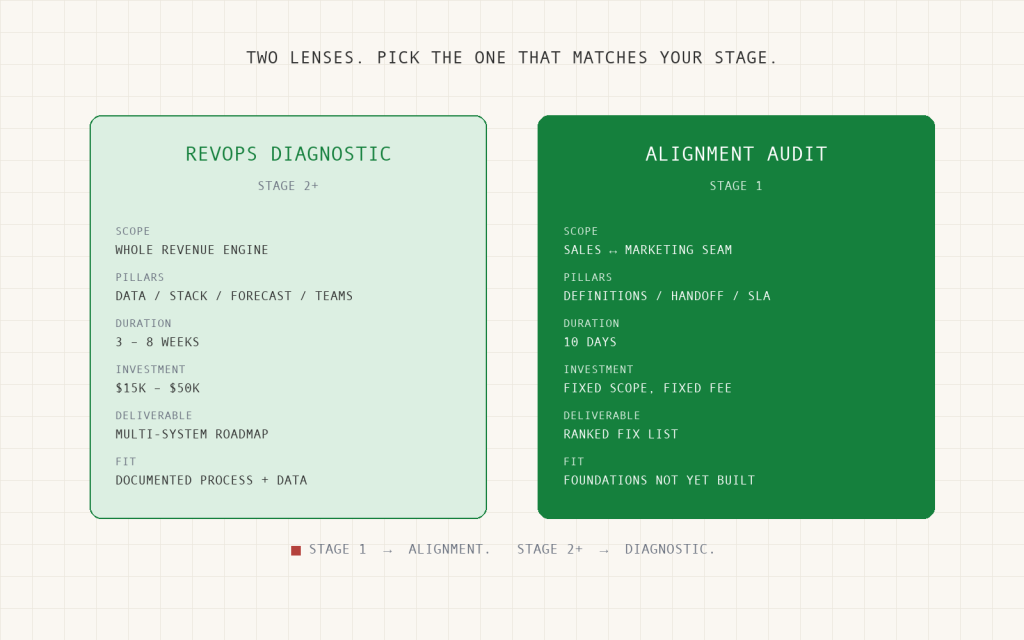
The table below lines the two engagements up on the six axes that drive the decision: scope, cost shape, deliverable, the team needed to act on findings, time to a usable finding, and when to choose each one. The right call is anchored to the stage you are actually at, not to the vendor pitching you.
| Axis | RevOps diagnostic | Marketing alignment audit |
|---|---|---|
| Scope | The full revenue engine: data integrity, pipeline visibility, tech stack alignment, forecasting accuracy, organizational revenue alignment. Five or more pillars (DevriX, Pedowitz, Hyperscayle frameworks). | The sales-marketing seam specifically: lead definitions, handoff process, SLA, messaging-process-data gaps. Narrower by design. |
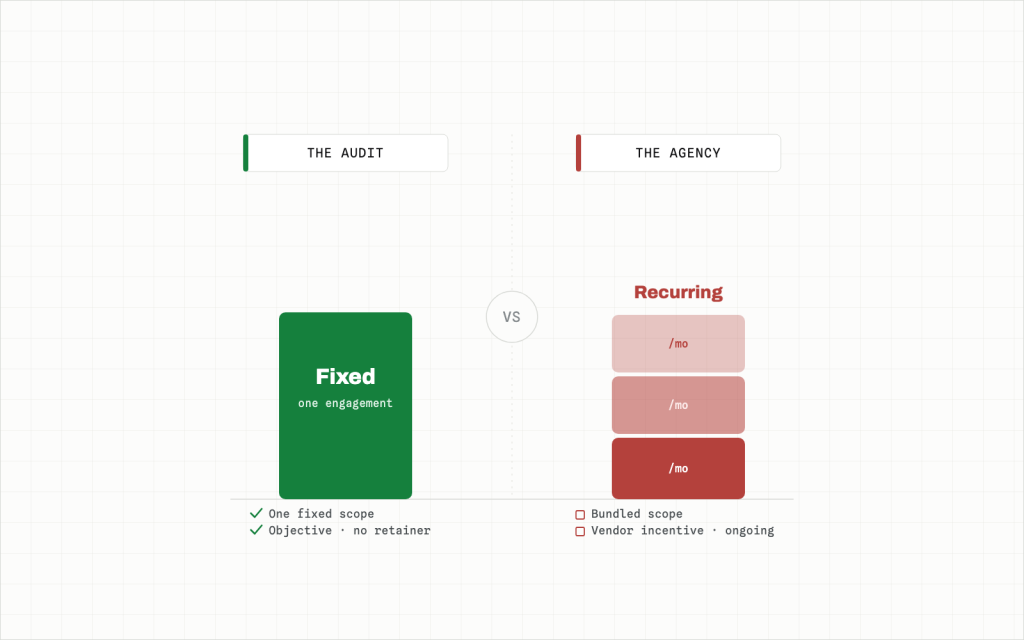
| Cost shape | Project engagement, typically $15K to $50K depending on scope. Often retainer or fractional RevOps thereafter (about $150K/yr for a full-time RevOps hire). | Fixed scope, fixed fee, known up front. No retainer. |
| Deliverable | Maturity assessment plus multi-system recommendations. Frequently bundled with the implementation team that vendor also sells. | Prioritized, ROI-framed recommendations the client's existing team or agency executes. No execution sold. |
| Team needed to act | Usually a dedicated RevOps function (or willingness to hire one). Findings touch multiple systems and departments at once. | Any existing marketing and sales leadership pair can execute. No new hire required. |
| Time to finding | 3 to 8 weeks typical. OpsEthic publishes a 14-day fast-track engagement. Hyperscayle publishes a 6-week diagnostic. Deeper engagements run 8 weeks. | Faster. Fixed-scope virtual engagement with a defined finish line. |
| When to choose | Stage 2+ on the published maturity models. You have documented processes, shared CRM data, an existing SLA, and now need to optimize what is already running. | Stage 1 (RevPartners "Organize"; Outreach and Insidea "Ad Hoc") on the published maturity models. You still need to define shared lead terms, document the handoff, and agree on what counts as qualified. Most pre-$10M ARR SMBs are here. |
Read the bottom two rows together. "Time to finding" tells you what each engagement costs in calendar terms; "when to choose" tells you which one earns its fee at your stage. The published RevOps Maturity Model vocabulary (Stage 1, Stage 2, Defined, Standardized) connects those two answers.
Both engagements show up in the same searches under different names: revenue operations audit, GTM alignment audit, go-to-market diagnostic. They are not the same thing. The decision rule is stage, not vocabulary.
When you need a full RevOps diagnostic (Stage 2+)
I do not run that engagement. If after reading this section you decide it's what you need, the right move is to talk to a RevOps consultancy. Hyperscayle, OpsEthic, Pedowitz Group, RevPartners, House of Revenue, DevriX, and ThinkRevOps all run it and publish their methodology openly. I will tell you honestly which side of the line you are on. I am not the right vendor for the diagnostic side.
The engagement earns its fee at Stage 2 (RevPartners and Insidea both call this layer "Defined"; Outreach uses similar language) and above. The signals you are actually at that stage, in plain English:
- You already have documented sales-marketing processes and a shared CRM with clean enough data that the diagnostic has something to read.
- You have a written SLA between sales and marketing. Most teams don't. Third-party surveys, including ArtemisGTM's, put the share of B2B orgs without one well into the majority.
- You have or are about to hire a dedicated RevOps function. Common practitioner thresholds: 10 to 15 sales reps, $5M+ ARR, Series A, or 25 to 50 employees (cited by Stage 2 Capital, Landbase, and captivatetalent).
- The problem is no longer "we don't know what's broken between sales and marketing." It's "multiple revenue systems need to be re-aligned at the same time": data, tech stack, forecasting, pipeline visibility, comp plans.
- You're PE-backed or scaling fast enough that EBITDA predictability is a board-level conversation.
The published maturity models are the empirical anchor, worth naming by source rather than waving at as "industry frameworks." RevPartners defines five levels (Organize, Operate, Align, Optimize, Transform). Outreach, Insidea, and Hyperscayle publish five-stage equivalents. Stage 2 is the same idea phrased differently across all four: audit where the funnel breaks down across systems, align to customer behavior. That's where the heavier engagement earns its fee. Below it, you're paying a diagnostic rate for a problem the models say isn't yet a multi-system problem.
One in-between case. If you're right at the Stage 1 to Stage 2 boundary, fractional RevOps is the third option. A part-time RevOps operator at 10 hours a month gives you diagnostic-grade thinking without a $150K full-time hire. Asia Corbett, senior RevOps manager and a public voice on practitioner sequencing, has endorsed lightweight "information-gathering process audits" before heavy RevOps work — a practitioner signal the alignment-first sequence is real.
When a focused alignment audit is the right entry point (Stage 1)
This is the slice I run. I'm telling you when to commission it and when not to. Same standard I just applied to the diagnostic side.
Stage 1 ("Ad Hoc" in Outreach and Insidea, "Organize" in RevPartners') is where most pre-$10M ARR SMBs with a lean GTM team live. In plain English: no shared, written definition of what a qualified lead is. No written SLA. Sales and marketing argue about lead quality every quarter, in almost the same words, with no resolution. The handoff happens over Slack and CRM with nothing catching what falls through. Leadership can't answer "where is pipeline leaking" from inside without taking a side.
What a focused marketing alignment audit produces, scoped to that stage:
- A lead-definition gap analysis: MQL and SQL on paper, with both teams on the same page or visibly not.
- A handoff process map with the named failure mode at each step.
- An SLA gap analysis grounded in third-party benchmarks (ArtemisGTM's surveys repeatedly put the share of teams with no formal SLA into the majority, and the share with documented MQL/SQL definitions in single digits).
- Prioritized, ROI-framed recommendations executable by the client's existing team or agency. Nothing here requires hiring a new function.
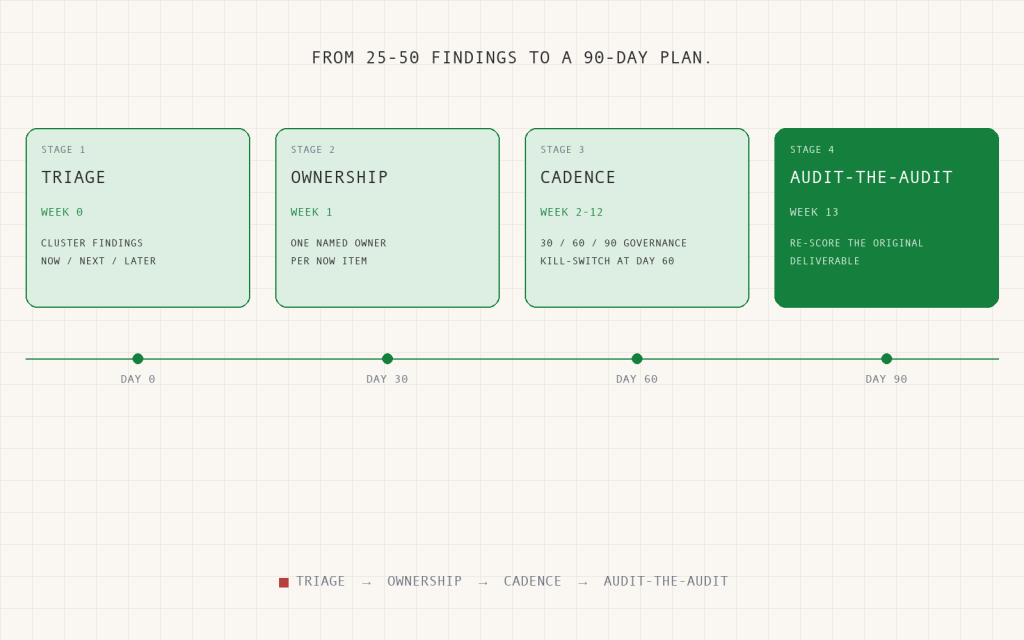
- An honest read on whether the work uncovered actually justifies escalating to a heavier engagement later. Sometimes it does. Most of the time at Stage 1, it doesn't yet.
The relief, for a Stage 1 buyer, is in three words: objective second opinion, fixed scope, no conflict of interest. A senior outside read at a known fee, with no incentive to inflate the problem, because there's no retainer waiting on the other side of the finding. If you want to see how the engagement is structured, the homepage walks through the diagnostic method and what's inside the audit deliverable.
One anti-pattern. Commissioning a full diagnostic at Stage 1 frequently produces a report the team isn't yet operationally mature enough to act on. That's the shelf-ware outcome the alignment audit is designed to avoid. The mechanism behind shelf-ware is usually the missing SLA; the Cycle 2 piece on the sales-marketing SLA walks through which leak the SLA addresses.
Symptoms that map to each lens
Three buckets. Read your own symptoms against them before you commit to either engagement.
Bucket 1: symptoms that map to an alignment audit (Stage 1)
- Sales says "these leads are garbage," marketing says "these reps don't follow up." Every quarter. Same fight. No resolution.
- No written SLA. Lead-stage definitions live in someone's head.
- The MQL queue fills steadily but the opportunity count doesn't move with it, and nobody can name why from inside.
- Pipeline is inconsistent month to month with no documented diagnosis.
Bucket 2: symptoms that map to a RevOps diagnostic (Stage 2+)
- Documented processes exist, but multiple revenue systems (CRM, marketing automation, sales engagement, attribution) are visibly out of sync.
- Forecasting accuracy is the C-suite's concern, not lead quality.
- The tech stack has accreted to 8 to 15 tools and no one can answer "what does each one do" or "are we paying for overlapping capability."
- The org has, or is about to hire, a dedicated RevOps leader and needs a maturity baseline to brief them with.
Bucket 3: diagnose before you commit
If you're not sure which bucket you're in, that's itself a Stage 1 signal, and the cheap, fixed-scope alignment audit is the lower-risk first move. If it surfaces Stage 2 maturity already in place plus revenue-system fragmentation underneath the seam, the audit will tell you so and recommend escalation to a named RevOps consultancy. Unpaid. No referral fee.
The honest call
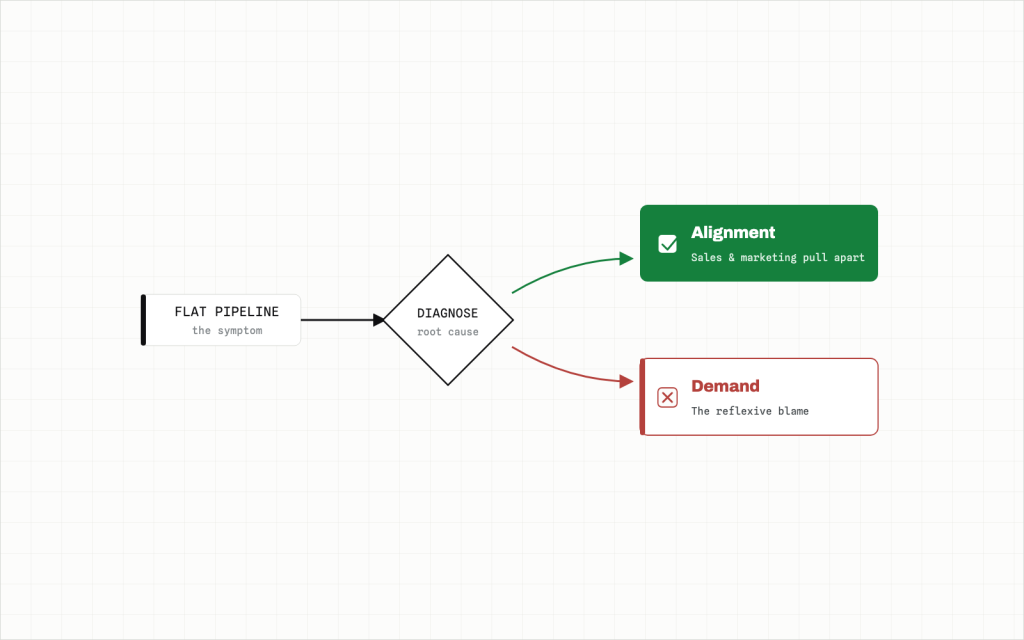
The question isn't "RevOps diagnostic or marketing alignment audit." It's "which stage are you actually at." The honest answer for most pre-$10M ARR SMBs with a lean GTM team is Stage 1, which means the alignment audit is the right-scoped first move. If you're past Stage 1, the heavier engagement is worth the fee. But you don't need to commission it from the same vendor selling you the alignment audit, and vice versa. The right diagnostician will tell you which side of the line you're on without selling you the engagement on either side.
If you're Stage 1 and want the objective second opinion before pointing real budget at a problem you can't yet name from inside, that's what the marketing alignment audit is for. Book the audit.
If you're Stage 2+, email and book a free intro call. I'll recommend a consultancy honestly, with no referral fee on my end. Diagnosis, not treatment, extended one vocabulary register up.