The harder question is what to do after a marketing audit, not how to commission one. The PDF arrives, the consultant signs off, and most teams open it twice, circulate it once, and quietly let it become shelf-ware. Industry data from The Growth Syndicate and adjacent research consistently puts the share of audits that stall after delivery somewhere around seven in ten. Not because the findings were wrong, but because nobody owns the second sentence on page 31.
This is a marketing audit action plan you can run in 90 days, with the team you already have, without signing a new retainer. It uses a four-stage architecture (Triage, Ownership, Cadence, Audit-the-Audit), anchored by an example prioritization matrix you can copy onto your own findings. It is published by a consultancy whose entire model is teaching the reader to execute alone. That is the only honest reason this piece exists on this site.
Why most marketing audits become shelf-ware
Twenty-five to fifty findings sit in a deck, ranked by the auditor's view of impact. Leadership nods. Two weeks pass. Nobody has touched finding number 17. By week eight the document is closed in a Drive folder and the pipeline is leaking in roughly the same places it was the week the audit started.
Three structural causes do almost all of the damage. First: no single accountable owner per finding. "Marketing" owns it, which means nobody does. Second: no impact-versus-effort sort, so easy items get done (refreshed nurture subject lines, the new homepage hero) while the high-leverage items (SLA definition, lead recycle path, MQL handoff) rot for ninety days. Third: no governance cadence after the kickoff. The audit becomes a one-time event with no follow-up.
The cost is well-documented. Gartner's 2024 research found 90% of sales and marketing executives say their functional priorities conflict, and only a small minority of B2B organizations have sufficient alignment to consistently drive profitable growth. IDC has estimated the drag at trillion-dollar scale globally. Harvard Business Review and follow-on lead-management research have repeatedly put the share of marketing-generated leads never contacted by sales near 73%. The fix is not more diagnosis. It is an execution architecture you can run.
What good looks like at day 0 / 30 / 60 / 90
A marketing audit 30 60 90 day plan should produce four observable outcomes, one at each checkpoint. If you reach Day 90 and cannot fill in all four rows, the audit became shelf-ware.
| Checkpoint | What good looks like |
|---|---|
| Day 0 (week 0) | 25–50 audit findings clustered into Now / Next / Later. Top 5–10 "Now" items selected by impact × effort. |
| Day 30 | Every "Now" finding has one named owner, one KPI, one due date. First 30/60/90 review on the calendar. |
| Day 60 | At least 3 "Now" findings shipped or measurably progressed. One stalled item killed and replaced, not carried. |
| Day 90 | One-page re-score of the original audit. The 5–10 "Now" findings closed, progressed, or formally rolled. |
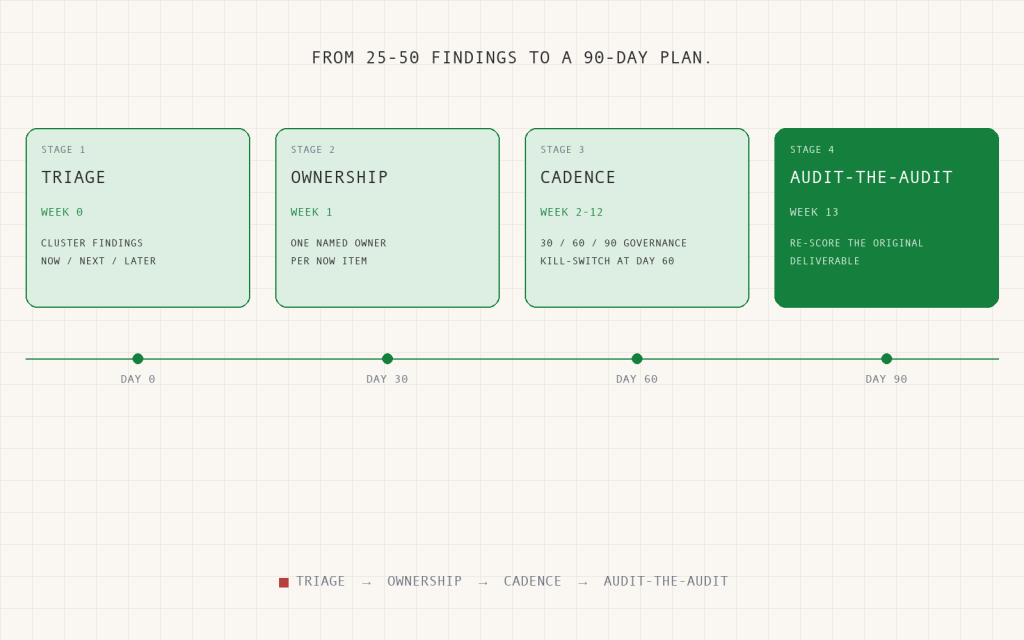
Most teams will recognize at least one row as already at risk by the end of week two. That is normal. The four stages below are what to do after a marketing audit so the rows hold: Triage, Ownership, Cadence, Audit-the-Audit.
Stage 1 — Triage (week 0): cluster 25–50 findings into Now / Next / Later
Prioritize marketing audit recommendations the way a triage nurse works a waiting room: not by who arrived first, not by who is loudest, but by who will die without intervention. Every finding gets two scores from one to five. Impact is what it does to pipeline, revenue, or the sales-marketing SLA when fixed. Effort is what it costs to ship: engineering hours, vendor contracts, process redesign, internal consensus.
Plot the findings on a five-by-five grid and the buckets fall out. High impact, low effort is Now: the top five to ten items you run in weeks 0–4. High impact, high effort is Next: weeks 4–8, often with a vendor or contract attached. Low impact, low effort is Later, batched into a quarterly cleanup. Low impact, high effort is Killed in the meeting where the matrix is built, not deferred politely, so the team's attention does not leak into them.
Use the auditor's impact scores. They did the hardest part of that work; do not re-derive it. The internal team scores effort, because only the people who will do the work know their own bandwidth. Rule of thumb: any item requiring more than 40 internal hours or external vendor procurement is high-effort.
State the capacity ceiling out loud. You cannot run more than five to ten Now items in 90 days with a team your size. The remaining 15–40 findings wait, get batched, or die. Teams that try to run twenty in parallel ship none of them.
What it looks like in practice. A realistic snapshot of a 25-finding alignment audit collapsed to a 90-day plan:
| # | Finding (from audit) | Impact (1–5) | Effort (1–5) | Bucket |
|---|---|---|---|---|
| 1 | No sales-marketing SLA defined | 5 | 2 | Now |
| 2 | MQL definition differs between sales and marketing | 5 | 2 | Now |
| 3 | Average response time on inbound leads: 42 hours | 5 | 3 | Now |
| 4 | No lead recycle path for sales-rejected MQLs | 4 | 2 | Now |
| 5 | Marketing ops dashboard pulls from 3 unsynced sources | 4 | 3 | Now |
| 6 | LinkedIn ad spend up 38% YoY, attribution unclear | 4 | 3 | Now |
| 7 | 8 of 12 nurture emails have <12% open rate | 3 | 2 | Now |
| 8 | No tracking on demo no-show rate | 4 | 2 | Now |
| 9 | Website hero has been A/B losing for 6 months | 3 | 2 | Now |
| 10 | Pricing page bounce rate 78% | 4 | 3 | Now |
| 11 | No firmographic enrichment on inbound forms | 4 | 4 | Next |
| 12 | CRM data hygiene: 19% of accounts missing industry | 3 | 4 | Next |
| 13 | Switch attribution from last-touch to multi-touch | 4 | 5 | Next |
| 14 | Re-platform marketing automation (HubSpot → Marketo) | 3 | 5 | Next |
| 15 | Build full ABM tier-1 outreach playbook | 4 | 5 | Next |
| 16 | Refresh ICP definition with sales input | 4 | 4 | Next |
| 17 | Reposition product page H1 copy | 2 | 1 | Later |
| 18 | Add G2 reviews widget to homepage | 2 | 2 | Later |
| 19 | Refresh blog category taxonomy | 1 | 2 | Later |
| 20 | Rebrand event landing pages | 2 | 3 | Later |
| 21 | New podcast launch | 2 | 5 | Kill |
| 22 | Re-do entire brand guidelines | 1 | 5 | Kill |
| 23 | Build internal AI content tool | 1 | 5 | Kill |
| 24 | Quarterly customer advisory board program | 2 | 5 | Kill |
| 25 | Re-do website navigation IA | 2 | 5 | Kill |
Caption: A realistic snapshot of a 25-finding audit collapsed to a 90-day plan. "Kill" is a category, not a failure. Five of twenty-five findings (20%) are deferred so the team can ship the Top-10.
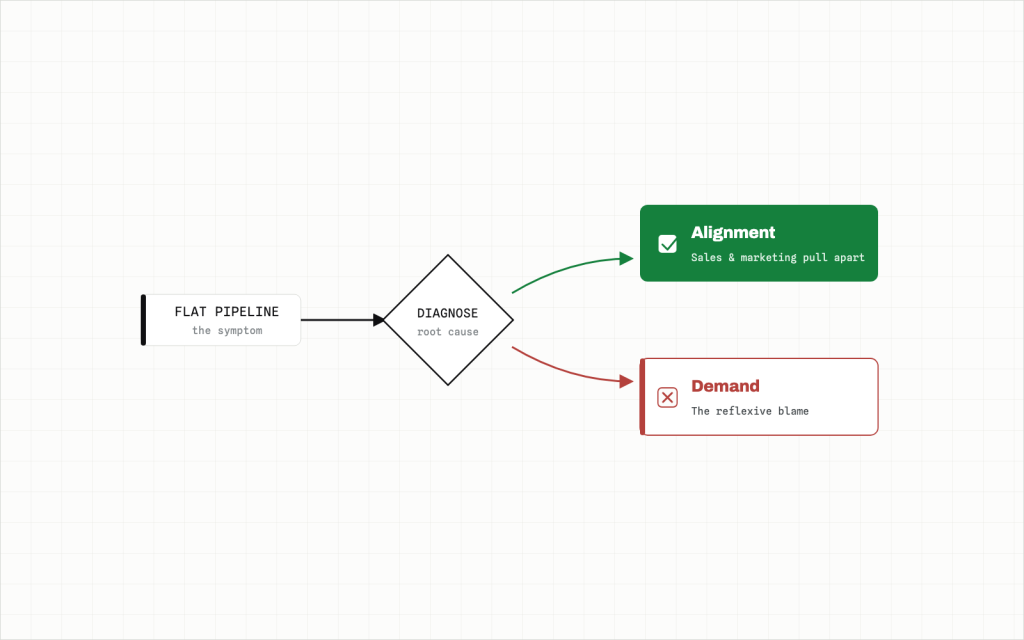
Two failure modes recur in week two. Teams under-score effort on cross-team items ("the SLA is just a one-page doc, that's a 2") and over-shoot the capacity ceiling; an SLA that requires sales, marketing, and ops to agree in writing is rarely a 2, because the bottleneck is consensus, not typing. And teams refuse to kill anything. If your Kill column is empty, you have not triaged, you have re-labeled. If the audit was alignment-shaped, the highest-impact Now items will cluster around the seam: the SLA, the MQL definition, the handoff, the response time. The SLA in particular is the one most teams botch. See how the sales and marketing SLA fits the leak map at https://tom.thereachbureau.com/sales-and-marketing-sla-which-leak/.
Stage 2 — Ownership (week 1): assign every Now finding to one accountable name
Marketing audit ownership is the non-negotiable. To implement marketing audit findings, every Now item gets one name, one KPI, one due date. Not a team. Not "marketing." Not "the agency." One person. A finding without an accountable owner is a finding without a future.
Three sub-cases cover almost every situation, each with different governance treatment.
Case A: the owner is internal, full-time
The owner has the time on paper but is rarely protected from the rest of their job. Fix it with calendar arithmetic: explicit blocked hours every week between Day 0 and Day 90, and the team knows those hours are off-limits. If the calendar block does not exist, neither does the ownership.
Case B: the owner is internal, part-time or overloaded
By far the most common case. The KPI must shrink to fit the hours. If the audit said "build a full MQL recycling pipeline" and the owner has six hours a week, the KPI is "document the recycle path for one segment and ship it manually." Smaller is shippable; a full-scope KPI on a quarter-scope owner ships nothing.
Case C: the owner is external — your existing agency, fractional CMO, or freelance specialist
External owners are the norm, not the exception. Industry sources put the share of B2B companies working with at least one agency, freelancer, or fractional executive at around 65%. When the owner is external, the founder's job changes from doing to steering, and the audit findings become the steering document. The agency does not set the priorities; the audit did.
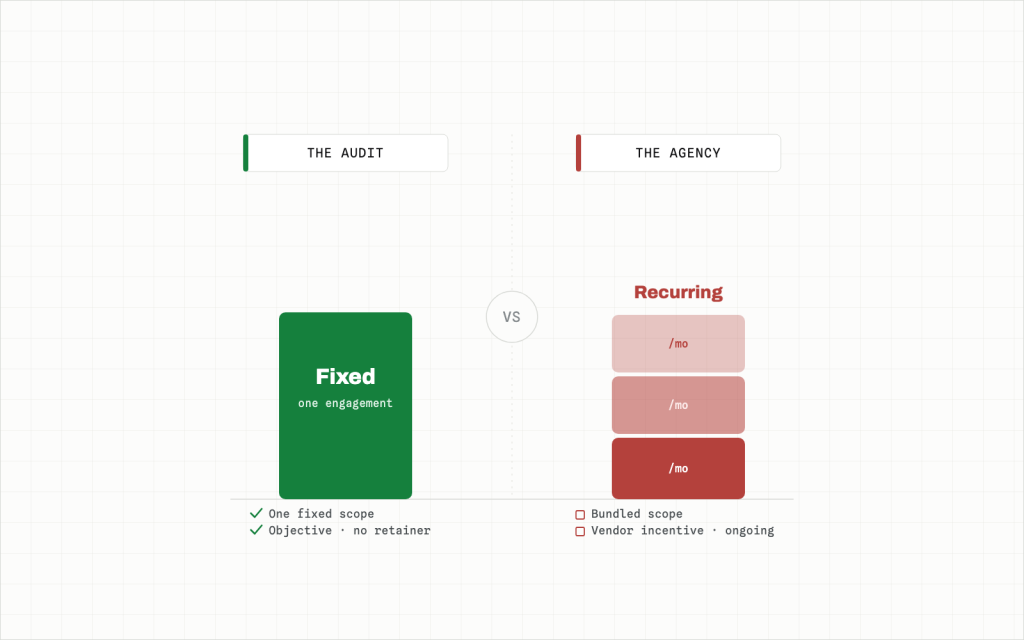
When the existing agency is the natural owner of a top-five item, forward those findings as-is with a five-day RSVP. Ask them to bid hours per finding, not a new retainer line. Findings the agency declines go back into Triage. (For the audit-vs-retainer distinction, see https://tom.thereachbureau.com/marketing-audit-vs-hiring-an-agency/.) The audit gives the founder bargaining power with the existing executor. If you cannot find an owner for finding number four and the agency refuses it, that is a procurement problem the audit cannot solve. The audit told you what. Finding the who is yours.
A single name column beats a four-column RACI for teams under twenty. At small-SMB scale, the only column earning its place is the R.
Stage 3 — Cadence (weeks 1–12): the 30 / 60 / 90 governance rhythm
A marketing audit 30 60 90 day plan is a rhythm, not a work plan. Work happens between checkpoints. The cadence exists to stop it from drifting. Three checkpoints, defined by what they produce.
Day 30 — produce a status grid
One row per Now finding. Columns: Owner / KPI / Due / Status (Green / Yellow / Red) / Last update. Fits on a single page. Read aloud in a 60-minute leadership review. "Continued discussion" is not a status. If an owner cannot name the status of their own finding in one sentence, the answer is red.
Day 60 — enforce the kill-switch
The rule that keeps the cadence honest: anything red at Day 30 must be green by Day 60 or killed. Killed is a category, not a failure. It preserves capacity for items that can ship, and the slot can be refilled from the Next bucket. The most common failure here is sentimental retention: the founder pushes to keep a red item alive because "it's almost there." If it could not move red to green in 30 days, it will not in 60. Kill it.
Day 90 — re-score the original Top-10
Covered in Stage 4 below.
Decision rights, in writing: the founder has unilateral kill-and-replace authority at every 30-day mark; owners have execution autonomy in between. The cadence itself is fixed: same day, same time, same agenda, same room. Variability in the cadence is the single biggest reason audits drift back to the shelf in week six; movable meetings get moved, then skipped, then forgotten.
Owners write a weekly asynchronous self-check in a shared doc: three lines, what shipped, what is blocked, what changed about the effort score. It exists to surface yellows before they turn red. If the audit's Now bucket is heavy on handoff items, the five places pipeline leaks at https://tom.thereachbureau.com/where-pipeline-leaks-between-sales-and-marketing/ is a useful checklist.
Stage 4 — Audit-the-Audit (week 13): a one-page re-score
Take the audit's Top-10 findings. Add one column to the status grid: Closed / Progressed / Rolled. Calculate one percentage at the bottom: closure rate. Six of ten closed equals 60%. The whole document fits on a single page.
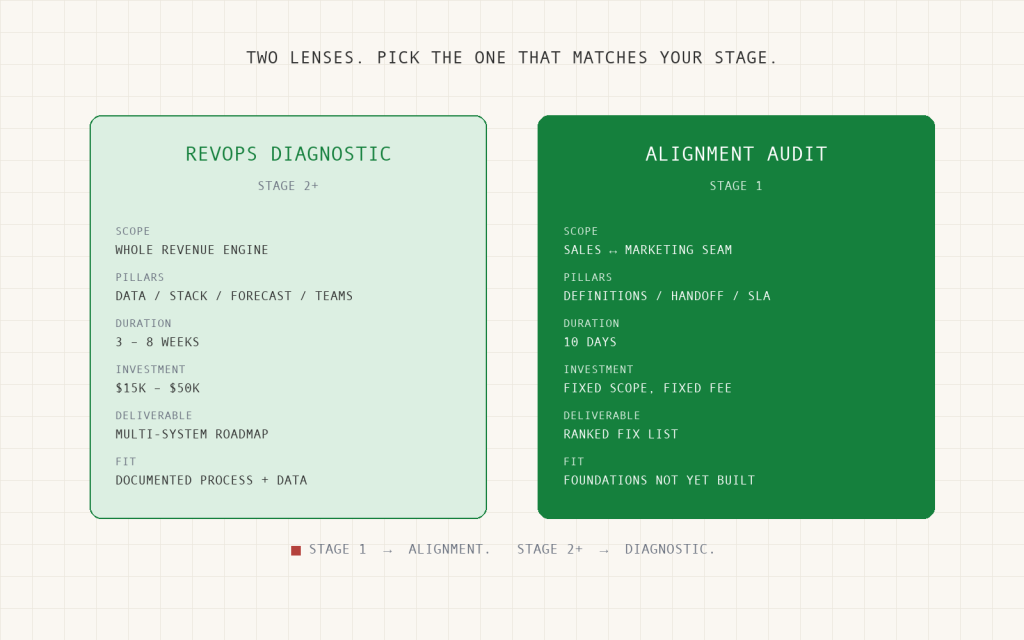
Frame the re-score as the input to the next diagnostic, whether that is another audit, a narrower RevOps review, or a self-run check at the next milestone. The re-score is not a grade for the audit itself; the audit's job ended at delivery. The re-score grades execution against what the audit said mattered.
Good looks like 60% closure on the Top-10, paired with a measurable pipeline outcome you can name in one sentence. An aggregated SaaS post-audit case study across mid-market B2B implementations recorded a 28% drop in cost-per-opportunity over a single 90-day cycle, anchored on a four-finding plan (UTM cleanup, attribution shift, budget shift from LinkedIn to Google Search, sunset of two unused tools). McKinsey's broader research on transformation execution suggests organizations with clearly prioritized, sequenced action plans are several multiples more likely to implement changes than those running open-ended programs. The mechanism is the same one this article walks: prioritization plus ownership plus cadence.
A 90% closure rate on low-impact items is not a success. It means the triage was wrong. Measure what you shipped against what you said mattered, not against what was easy. Realistic targets: 60% closure is the strong outcome. Above 80% usually means over-triaged. Below 40% means the cadence broke down, almost always because the kill-switch was not enforced.
Conclusion — Diagnosis ends, execution begins
What to do after a marketing audit is to build an execution architecture. Not commission a second audit, not hire a new agency, not relitigate the findings. Triage to cluster the findings, Ownership to put one name on every Now item, Cadence to run the 30 / 60 / 90 rhythm, Audit-the-Audit to re-score the Top-10 at Day 90. Good looks like 60% closure on the items the audit said mattered, paired with a pipeline outcome you can state in a sentence.
This consultancy does not offer to run the 90 days. Doing so would break the diagnostic-not-treatment model that makes the audit credible. If the questions above (who owns finding number four, how fast do leads get touched, is the MQL definition written down) are landing uncomfortably and you have not had an outside read of where your sales and marketing are leaking, the right next step is the diagnostic. Book the marketing alignment audit at https://tom.thereachbureau.com/, or see how it works at https://tom.thereachbureau.com/#how and what's inside at https://tom.thereachbureau.com/#inside. If the 90 days just went well and you are ready for the next cycle, book the next diagnostic cycle at https://tom.thereachbureau.com/#book.
Diagnosis ends. Execution is yours.