A marketing audit vs hiring an agency is a choice between two very different ways to spend money — and only one of them requires you to already know what's wrong. An audit is a fixed-scope diagnosis. An agency is ongoing execution. Both cost real money, but they answer different questions: an audit tells you what's broken, an agency does the work. Most teams reach for the agency first, before they can name the actual problem. This is an honest comparison of what each one gets you, what each one commits you to, and a simple rule for which to choose when.
Marketing audit vs. hiring an agency — at a glance
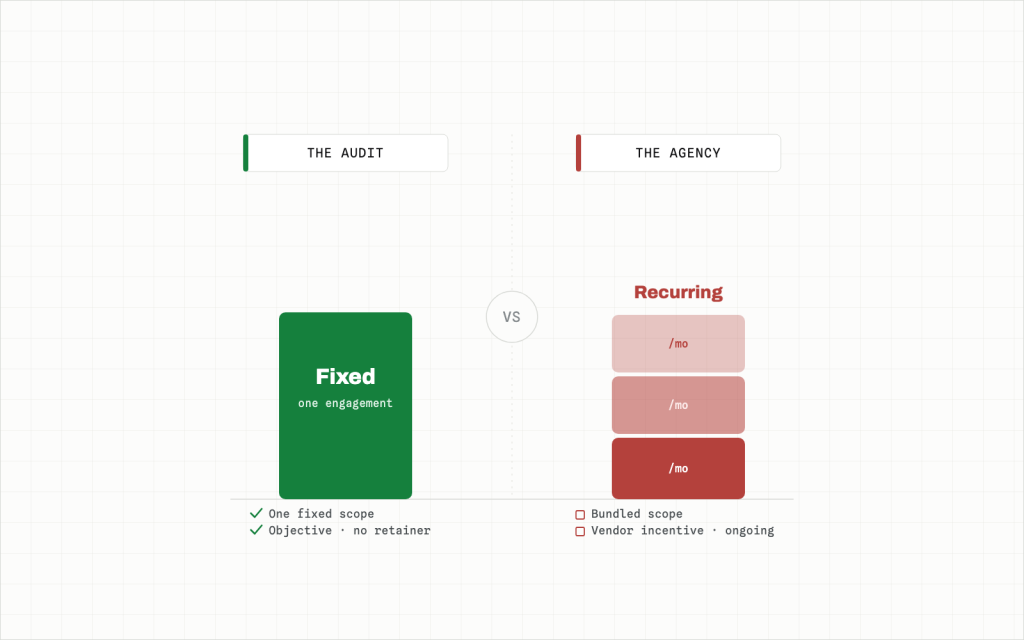
The two overlap less than the search results suggest. An audit is a diagnostic: a defined engagement that produces a deliverable and ends. An agency retainer is a relationship: ongoing capacity that runs until you cancel it. The table below lines them up on the dimensions that actually drive the decision — purpose, output, commitment, and the one most comparison pieces skip, because most are written by agencies: conflict of interest.
| Marketing audit | Hiring an agency | |
|---|---|---|
| Purpose | Diagnose what's broken | Execute the fix |
| Output | A prioritized set of recommendations | Campaigns, assets, ongoing work |
| Commitment | Fixed scope, defined end date | Open-ended retainer until you cancel |
| Cost shape | One-time, known up front | Recurring monthly fee |
| Best when | You can't yet name the real problem | The problem is diagnosed; you need hands |
| Conflict of interest | None if the diagnostician doesn't sell the fix | Built in when the same firm diagnoses and bills the work |
Read the bottom two rows together. They're where the decision usually lives. If you already know what's wrong and just need execution capacity, an agency is the obvious call. If you don't — and most teams don't — paying a retainer to figure that out is the expensive way to buy a diagnosis you could have gotten on a fixed scope.
What a marketing audit actually gets you
An objective outside read
The value of an audit is the objectivity. You get fresh eyes from someone who hasn't been in the weeds of your funnel for the last two years. That distance is the whole point. An internal team can review its own marketing, but it can't be objective about it — they built it, they have theories about why it works the way it does, and they're invested in those theories being right.
This is the consistent argument across the marketing-audit literature, including explainers from firms like LocaliQ and SmartBug: an outside perspective surfaces problems an in-house team has stopped seeing. You can't read the label from inside the jar.
A fixed scope and a finish line
An audit is a defined engagement. There's a scope, a deliverable, and an end. You know going in roughly what it will cost and when you'll have an answer. That's the opposite of an open-ended relationship that bills every month whether the work that month moved a number or not.
For a leader who's wary of commitment, the finish line is the feature. You're not signing up for a relationship. You're buying a diagnosis.
A diagnosis you can hand to anyone
The deliverable from a good audit is recommendations, ranked by impact — not a sales pitch for who should implement them. That matters, because it means the diagnosis is portable. Your in-house team can execute it. Your existing agency can execute it. You can take it to a new agency and brief them precisely instead of paying them to discover the problem first.
If you want to see what a finding looks like in practice, the deliverable breakdown shows the shape of it: a specific problem, why it's costing you, and what to do about it. That's the thing you hand to whoever does the work.
What hiring an agency actually gets you
Execution capacity
An agency gives you hands. It's a team that does the work — runs the campaigns, builds the assets, manages the channels — that your in-house people don't have the capacity or the specialist skill to do. That's a real and often necessary thing to buy. The question is never whether agencies are useful. They are. The question is timing.
Execution capacity is the right thing to buy once you know what work needs doing. It's the wrong first purchase when you don't, because you end up paying skilled people to act on a problem definition nobody has actually confirmed.
An ongoing relationship (and an ongoing bill)
The retainer is the agency's default shape. You pay a recurring fee for continuous work. Scoped to a known problem, that's good value — the team builds context, gets faster, and compounds. Scoped to "figure out what's wrong and then fix it," it's expensive, because you're funding the diagnosis at execution rates, month over month, while the meter runs.
This is the trigger a lot of leaders recognize too late: six months into a retainer, results are still unclear, and it's hard to say whether the work is wrong or the problem was never the one being solved. Clarity without that trap is the whole reason the audit-not-retainer wedge exists.
The conflict-of-interest problem
Here's the part most "audit vs. agency" articles can't say honestly, because an agency wrote them. When the same firm both diagnoses your problem and sells you the fix, it has a structural incentive to find work it can bill. That's not malice. It's structure. A firm whose revenue comes from execution will, on average, diagnose more execution.
An objective marketing audit removes that incentive by separating the two. A diagnostician who doesn't sell the implementation has no reason to inflate the problem — there's no retainer waiting on the other side of the finding. That's not a knock on agencies. It's just the reason you don't ask the person who profits from the answer to also be the one who decides what the answer is.
The decision rule: diagnose before you commit
Get the audit first when…
Get an audit first when you can't cleanly name what's broken. The signals are familiar: results are inconsistent and you can't say why; a quarter underperformed and the post-mortems contradict each other; sales and marketing are blaming each other and you can't tell who's right from the inside. A second opinion before committing budget is exactly what an audit is for — and a leader who wants that read before signing a retainer is the ideal candidate for one.
If you're not even sure you have a problem worth auditing, that's worth pinning down first. Where pipeline usually leaks between sales and marketing walks through the common failure points — a fast way to check whether the symptoms you're seeing are real.
Go straight to an agency when…
Go straight to an agency when the problem is already diagnosed and what you're missing is purely capacity. You know the messaging is off and you've defined how it should change — you just need people to rebuild it. You know which channel is underbuilt and you need a team to build it. When the diagnosis is settled and confident, the audit step is redundant. Buy the hands.
The honest test: can you write the brief? If you can hand an agency a clear, specific problem statement and know it's the right one, you're past the diagnostic stage. If the brief would really be "figure out why our numbers are soft," you're not — and an agency will charge retainer rates to do the figuring.
Why "audit, then execute" usually wins
For most teams the answer isn't audit or agency. It's audit, then execute. You diagnose first, then point the budget — in-house team or agency — at the real problem instead of guessing. The diagnosis makes the execution money work harder, because it's aimed. And it's a small spend that de-risks a large one: a fixed-scope audit costs a fraction of a year on retainer, and it tells you whether that retainer should exist and what it should do.
The order matters more than the choice. Diagnose, then commit. That sequence is the entire argument.
FAQ
Is a marketing audit worth it before hiring an agency?
Usually, yes. The audit tells you what to brief the agency on, so you're not paying a retainer to figure out a problem you could have diagnosed in a fixed-scope engagement first. It aims the budget before you spend it — which tends to make the agency work both cheaper and more effective.
Can't my in-house team just audit our own marketing?
They can review it, but they can't be objective about it — they built it. The whole value of an audit is the outside read from someone who isn't in the weeds and has no stake in the existing theories. Internal review and objective audit aren't the same exercise.
What's the difference between an audit and an agency retainer?
An audit is a fixed-scope diagnosis with a deliverable and an end date. A retainer is ongoing execution that bills every month until you cancel. One tells you what's wrong; the other does the work. They solve different problems, which is why the real question is which comes first.
When should I get a marketing audit?
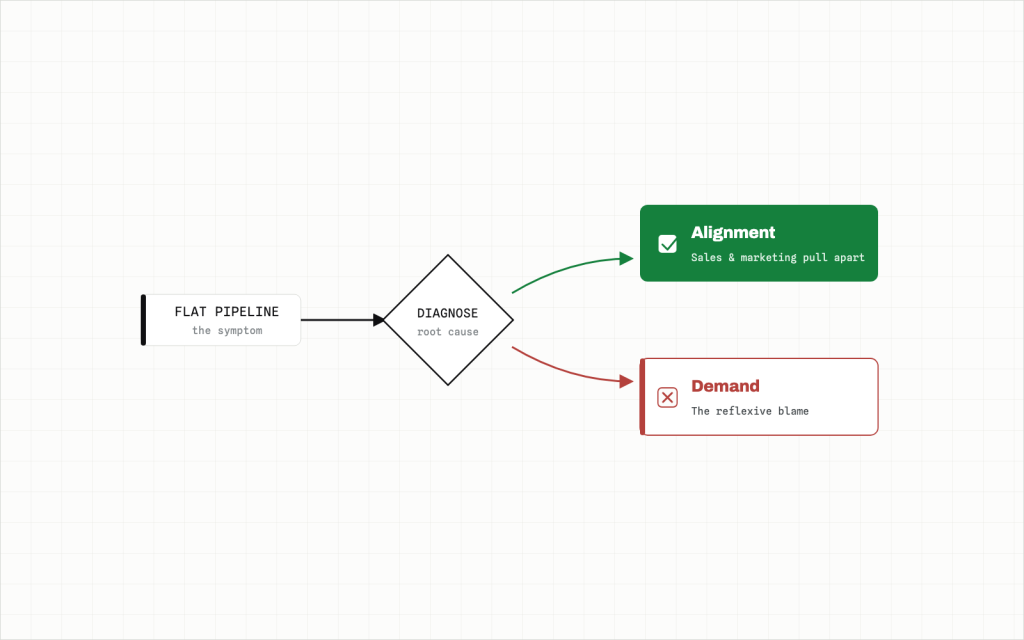
When results are unclear, after a leadership or audience change, or before committing real budget to execution. And any time sales and marketing are blaming each other and you can't tell from the inside who's right — that's a misalignment you want diagnosed objectively, not argued about internally.
Does the consultant who audits also do the work?
Not here — by design. Diagnosis stays separate from execution so there's no incentive to inflate the problem into a billable retainer. You take the prioritized recommendations to your own team or your existing agency. The diagnosis is yours to act on however you choose.
The question isn't audit or agency. It's which first.
An agency and an audit aren't competitors. They're sequential. The agency is the right call once you know what's broken and need hands to fix it. The audit is the right call when you don't — when you need an objective read before you point real budget at a problem you can't yet name. Most teams skip the first step and pay for it on the second. Diagnose, then commit, then point the budget — in-house or agency — at the thing that's actually wrong.
If you're weighing a retainer and want the objective second opinion first, that's exactly what the marketing alignment audit is for. Book the audit — get the diagnosis before you commit to anyone's execution.